 How-to
Pest Control Documentation: How to Prepare for Health Inspections
Last Updated: November 2, 2026
Quick Summary
Pest control documentation is the written record of every pest management activity at your facility: inspections, treatments, monitoring, and corrective actions. Build a dated master binder or digital folder, file your service agreement, log every visit with technician name and license number, and review the file monthly for gaps.
- Log every service visit with date, time, technician name, and license number.
- Record inspection findings same-day, including pest evidence, droppings, nests, and entry points.
- Map monitoring devices with numbered bait stations and traps.
- Keep every record for at least one year, and service agreements for as long as the contract runs.
- Organize records by month, not pest type, so an inspector can follow trend tracking.
Table of Contents
- How to Document Pest Control for Health Inspections: Step-by-Step
- Pest Control Checklist for Food Industry: What to Include
- Pest Control Inspection Report Template: Free Ready-to-Use Format
- How to Organize and Retain Pest Control Records
- What to Do When Records Are Missing or an Inspector Finds a Violation
- Frequently Asked Questions
How to Document Pest Control for Health Inspections: Step-by-Step
Pest control documentation is the written record of every pest management activity at your facility: inspections, treatments, monitoring, and corrective actions. Commercial clients are often reminded that if it isn't written down, it didn't happen.
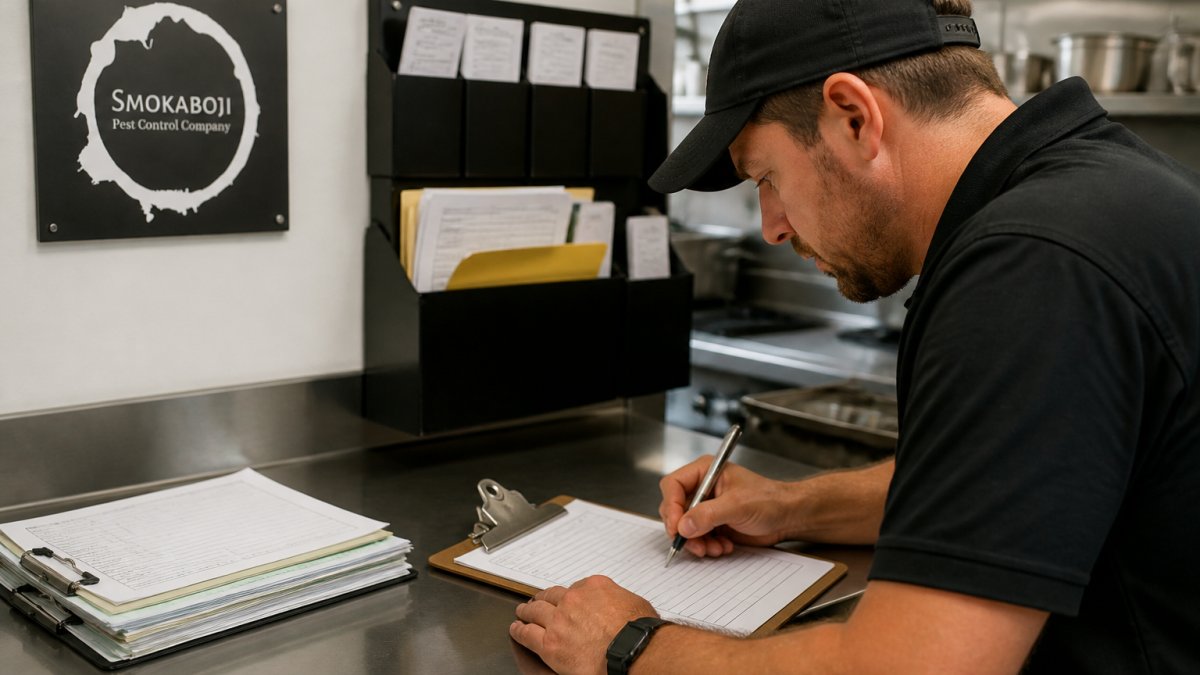
- Build a master binder or digital folder labeled "Pest Control Documentation," dating every entry.
- File your service agreement with provider name, license number, and scope of work.
- Log every service visit with date, time, technician name, and license number.
- Record inspection findings same-day: pest evidence, droppings, nests, entry points.
- Document every pesticide application with product name, label, and location.
- Map monitoring devices with numbered bait stations and traps.
- Write corrective actions with assigned responsibility and follow-up date.
- Review the file monthly for gaps.

Watch out: The most common failure is a stack of service reports with no dates, device numbers, or follow-up notes. An inspector reads that as no program at all.
Follow these steps in order to build a complete pest control file.
| Step | What to do |
|---|---|
| 1 | Build a dated master binder or digital folder |
| 2 | File the service agreement with provider name and license number |
| 3 | Log every visit with date, time, technician name, license number |
| 4 | Record inspection findings same-day |
| 5 | Document each pesticide application with product name, label, location |
| 6 | Map numbered bait stations and traps |
| 7 | Write corrective actions with responsibility and follow-up date |
| 8 | Review the file monthly for gaps |
Pest Control Checklist for Food Industry: What to Include
A food industry pest control checklist should cover every record an inspector may request:
- Current service agreement with provider details
- Technician license numbers for every visit
- Service log with date and time of each visit
- Inspection findings, including pest evidence and conducive conditions
- Pesticide application records with product label and location
- Monitoring device map: bait stations, traps, and inspection dates
- Corrective actions with follow-up visit dates
- Sanitation and exclusion notes
- Staff training records and assigned responsibility
Pest Control Inspection Report Template: Free Ready-to-Use Format
A pest control inspection report template captures findings, actions, and follow-up in one place. Copy this format into Word or Excel:
Header: Service address, property information, date and time, technician name, technician license number.
Findings: Pest activity observed (rodent, insect, droppings, nests), location, and photos.
Devices: Device number, type (bait station, trap), treatment area, inspection result.
Applications: Pesticide type, product label, application location, application date.
Actions: Corrective action, assigned responsibility, follow-up date.
Sign-off: Technician signature, facility manager signature.
When ready to bring in a provider, see our guides to comparing commercial pest control quotes and how to compare local exterminator service contracts.
Watch out: Photos without labels are nearly useless. Name the location and date on every image.
How to Organize and Retain Pest Control Records
Keep every record for at least one year, and service agreements for as long as the contract runs. Organize by month, not pest type, so an inspector can follow trend tracking in a straight line.
A digital folder with scanned reports works well if staff can pull a record within minutes. Paper binders fail when a manager is out sick.
What to Do When Records Are Missing or an Inspector Finds a Violation
Missing records are fixable if you act fast. Contact your provider for duplicate service reports, then write a short memo explaining the gap and your corrective action.
If an inspector cites a violation, respond in writing with a follow-up visit scheduled, structural repair notes, and an exclusion plan. Inspectors look for a documented response, not a promise.
Frequently Asked Questions
What records do health inspectors look for when reviewing pest control?
Inspectors typically ask for your current pest control service agreement, service logs with dates and findings, pesticide application records including product names and locations, monitoring device maps, and documented corrective actions. They want to see a complete paper trail showing regular service, identified pest evidence, and follow-up. Missing any of these can trigger a violation. Keep everything in one binder or digital folder so you can produce it quickly during an inspection.
Can a pest control checklist be kept digitally?
Yes. A pest control checklist Excel format or a shared spreadsheet works well for digital recordkeeping. Store service reports, inspection findings, and corrective actions in a cloud folder with clear file names by date. Digital records are easy to search, back up, and share with your pest provider. Just make sure you can access them offline or print them if an inspector requests a physical copy. Many health departments accept digital records as long as they are legible and complete.
How often should pest control inspections and treatments be documented?
Document every service visit, whether it is a routine inspection or a treatment. For most food-service establishments, that means at least monthly service records, plus any additional visits for follow-up or corrective action. Log the date, time, technician name and license number, findings, and actions taken. If you spot pest activity between visits, record it immediately in your pest activity log. Consistent documentation shows inspectors that pest control is an ongoing program, not a one-time fix.