 listicle
Pest Control Pricing for Businesses: What to Expect
Table of Contents
- Pest Control Pricing for Businesses Explained
- Factors Affecting Commercial Pest Control Costs
- One-Time vs. Recurring Service Plans and Contract Options
- Commercial Pest Management Service Frequency and Planning
Last Updated: August 30, 2026
Pest Control Pricing for Businesses Explained
Pest control pricing for businesses varies dramatically based on facility size, pest type, and service frequency. What a restaurant pays monthly looks nothing like what a manufacturing plant spends quarterly. At Smokaboji Pest Control, we've worked with commercial clients across Northwest Iowa and Southwest Minnesota long enough to know that most business owners underestimate what comprehensive pest management actually costs, and what corners they shouldn't cut.
Commercial pest control isn't a commodity. A one-time spray for a minor ant problem costs nothing like ongoing rodent exclusion for a food processing facility. Understanding the real drivers behind pricing helps you budget accurately and avoid the false economy of choosing the cheapest quote.
Factors Affecting Commercial Pest Control Costs
Pest control pricing for businesses hinges on five core variables. Facility size is the first lever: a 5,000-square-foot office building costs far less to treat than a 50,000-square-foot warehouse. Infestation severity matters just as much. A preventative quarterly maintenance plan for a pest-free facility runs at one price point; an active cockroach infestation requiring intensive treatment and follow-up visits runs at another, sometimes triple the cost.
Pest type and treatment complexity drive costs upward fast. Spiders around a dock are straightforward; bed bugs in a multi-unit commercial building require specialized heat treatment, chemical protocols, and verification visits. Rodent exclusion with structural gaps means paying for exclusion materials, sealing, and ongoing monitoring.
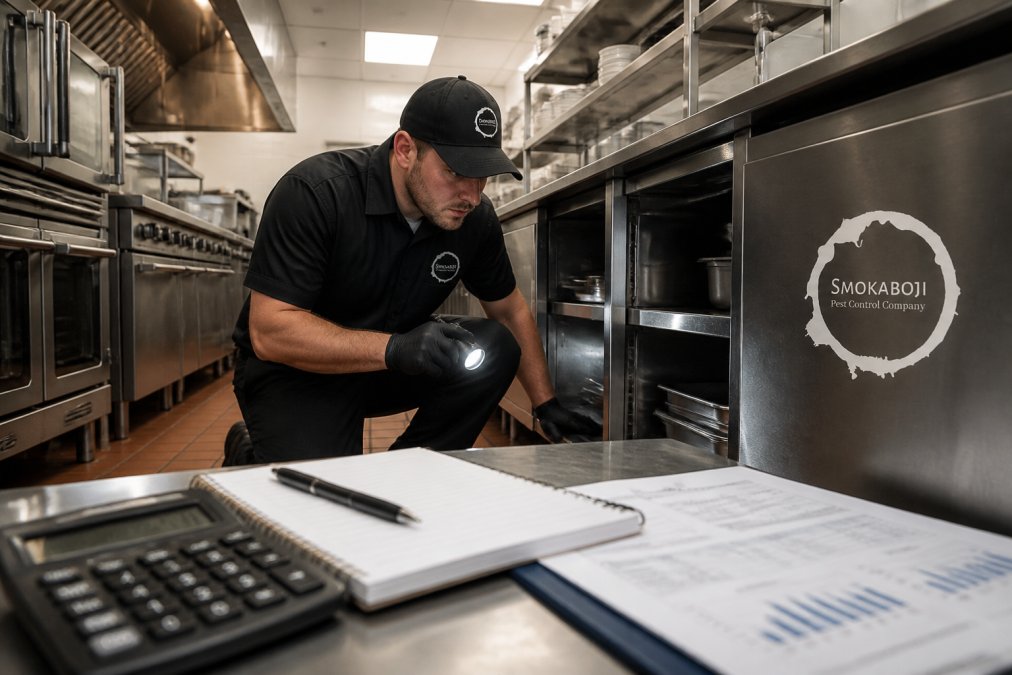
Facility type determines baseline pricing. Restaurants and food service face stricter compliance requirements and higher pest pressure, so quotes run higher (the FDA). Manufacturing plants with outdoor loading docks need different protocols than office buildings. Compliance standards, whether FDA audits, health department inspections, or industry-specific regulations, add cost because documentation, frequency, and treatment protocols become non-negotiable.
Service frequency is the final variable. Monthly visits cost more annually than quarterly visits, but they prevent infestations from escalating. The real cost isn't just the visit fee; it's the operational disruption, liability exposure, and potential regulatory fines if an infestation goes undetected.
One-Time vs. Recurring Service Plans and Contract Options
One-time treatments are rare in commercial settings because they rarely solve the problem permanently. Recurring maintenance plans, the industry standard for commercial pest control pricing for businesses, come in three tiers: monthly service for high-risk facilities like restaurants and food processing; quarterly plans for most office buildings and retail spaces; and annual contracts for preventative maintenance in low-risk facilities.

Contract terms matter more than most business owners realize. One-year contracts lock in pricing but limit flexibility. Multi-year agreements often offer discounts but commit you to a provider. Month-to-month plans cost more per visit but let you switch providers without penalty.
Service agreements should specify response time for urgent issues, treatment protocols, documentation requirements, and what happens if an infestation recurs. Many providers offer guarantee clauses: if pests return within 30 days of treatment, they re-treat at no charge. That's worth negotiating into any commercial contract.
Commercial Pest Management Service Frequency and Planning
Service frequency depends entirely on facility risk profile and regulatory environment. A retail store with no food handling might need quarterly visits. A restaurant or bakery needs monthly service, minimum. Food processing and pharmaceutical facilities often require bi-weekly or weekly protocols to meet compliance standards (the FDA).
The real calculation isn't "what's the cheapest option?" It's "what frequency prevents operational disruption and regulatory risk?" A single cockroach sighting in a restaurant kitchen can trigger health department inspection, temporary closure orders, and reputational damage costing thousands (the FDA).
Seasonal pest pressure should drive your service calendar: spiders in fall, rodents in winter, flies in summer. Integrated pest management combines preventative measures (sanitation audits, exclusion work, landscaping adjustments) with chemical treatment. This layered approach costs more upfront but reduces long-term service frequency and chemical dependency.
| Service Frequency | Best For | Typical Interval | Key Consideration |
|---|---|---|---|
| Monthly | Restaurants, food service, healthcare | Every 30 days | Compliance-driven; highest cost but prevents liability |
| Quarterly | Offices, retail, light manufacturing | Every 90 days | Standard for most commercial facilities |
| Bi-annual | Low-risk offices, storage facilities | Every 6 months | Preventative only; not suitable for active infestations |
| Annual | Preventative maintenance only | Every 12 months | Minimal cost; insufficient for most commercial use |
Frequently Asked Questions
Q: What factors influence the price of business pest control services?
A: Pricing depends on facility size, pest type, infestation severity, treatment complexity, service frequency, and facility type (restaurant, warehouse, office). Commercial pest control contract terms, compliance requirements, and geographic location also affect costs. Smokaboji Pest Control assesses your specific situation to provide an accurate quote based on your business needs.
Q: Is a monthly or quarterly pest control plan better for businesses?
A: Monthly plans offer more frequent monitoring and faster response to pest activity, ideal for high-risk facilities like food service or healthcare. Quarterly plans work well for lower-risk commercial spaces with preventative maintenance focus. The right frequency depends on your industry, facility type, and pest pressure. Smokaboji Pest Control customizes service frequency to match your business requirements.
Q: What should be included in a commercial pest control contract?
A: A solid commercial pest control contract template should specify service scope, treatment protocols, service frequency, response times, compliance standards, liability coverage, and pricing terms. It should outline what pests are covered, equipment used, safety procedures, and emergency response availability. Review contractual obligations carefully and discuss any hidden costs upfront. Smokaboji Pest Control provides transparent agreements tailored to your business operations.
Choosing the right pest control service for your business comes down to matching service frequency and contract terms to your actual risk profile, not just picking the lowest bid. Smokaboji Pest Control helps commercial clients across the region assess facility-specific risks and design service plans that prevent costly operational disruptions while staying within budget. Get started with a customized quote and facility assessment today.
This article was written using GrandRanker